
12 hr
Death Valley Full-Day Guided Adventure from Las Vegas
Journey through America's hottest desert, historic ghost towns, and dramatic sand dunes on this immersive excursion
Reserve
Hand-picked by our editors — only the best 5 experiences from 12 reviewed.
Verified partners for every tour, free cancellation where available, and instant confirmation on every booking.
12 hr
Journey through America's hottest desert, historic ghost towns, and dramatic sand dunes on this immersive excursion
Reserve
24 hr
Journey through America's hottest national park and explore an abandoned gold rush settlement
Reserve
24 hr
Explore America's most extreme desert landscape on a guided day trip with lunch and park entry included
ReservePrices from verified partners. Availability updates in real time at checkout. Free cancellation policies apply where shown.
The landmarks, rooms, and views travelers on this tour remember — all visible on a single visit.
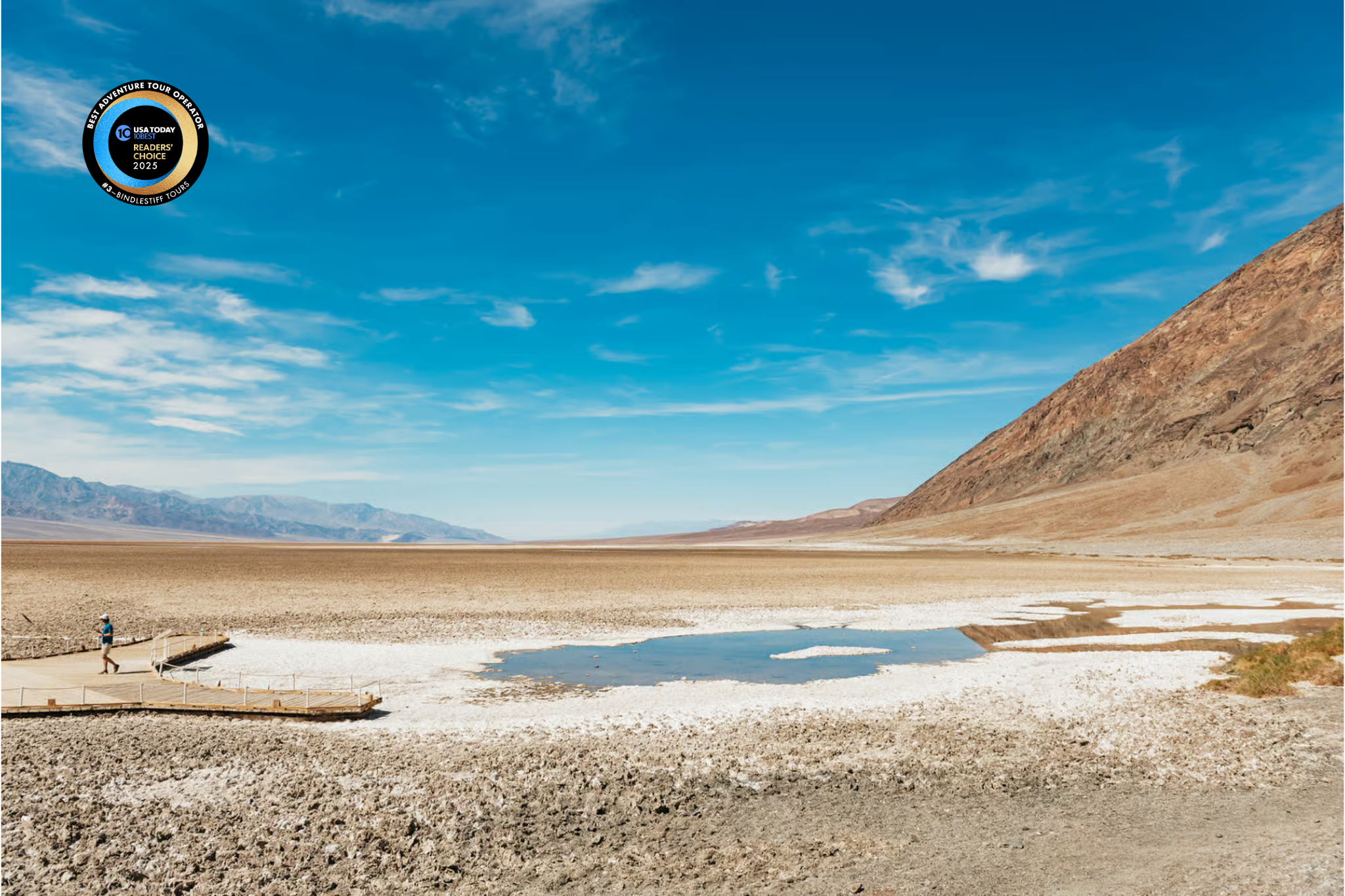
At 282 feet below sea level, this is the lowest point in North America and features vast, hexagonal salt polygons.
These eroded badlands offer stunning, golden-hued landscapes that are particularly popular for photography at sunrise.
These dunes reach heights of over 100 feet and provide a quintessential desert experience in Death Valley National Park.
This nine-mile scenic loop showcases colorful volcanic and sedimentary hills known for their unique mineral hues.
A large volcanic crater created by a steam explosion approximately 2,100 years ago.
A guided death valley bus tour from los angeles provides stress-free navigation, while a private road trip offers superior freedom to explore the Mojave Desert at your own pace.
| Feature | Top pick Organized Bus Tour | Self-Drive Trip |
|---|---|---|
Travel Convenience |
Professional driver provided | Requires multi-hour driving |
Flexibility |
Fixed itinerary structure | Full control over schedule |
Cost Efficiency |
All-inclusive single price | Fuel and vehicle costs |
Social Interaction |
Group environment provided | Private party only |
Navigation Requirements |
None for passengers | Detailed map planning needed |
Safety in Desert Conditions |
Expert desert logistics | Requires own vehicle preparation |
| See tickets → |
Verdict: Securing death valley bus tour from los angeles tickets remains the preferred choice for those wanting to avoid long-distance driving, whereas the self-drive option is ideal for travelers prioritizing independent exploration of this iconic landmark.
Choose your ticket, select your date, and reserve in under two minutes. Secure checkout handled by our verified partner.
Instant confirmation by email, with a mobile voucher you can save offline. No printing, no queuing at a collection desk.
Arrive at the entrance, show your voucher on your phone, and walk in. Most tickets include priority or skip-the-line access.
Practical details for your visit straight from our verified partners — hours, access, rules, and how to get there.
Wear breathable, light-colored clothing and sturdy hiking shoes suitable for uneven desert terrain. A hat and sunglasses are essential for a death valley bus tour from los angeles.
Keep all belongings secured in the bus during stops. Large backpacks are generally discouraged on short excursions to ensure comfort during your death valley bus tour from los angeles.
The diverse light and landscape make this a premier location for landscape photography. Always respect natural surroundings while framing shots during your death valley bus tour from los angeles.
While major viewing points offer accessibility, the desert floor can be challenging. Confirm tour operator vehicle accessibility for your death valley bus tour from los angeles.
Cell service is extremely limited or non-existent in much of the park. Do not rely on mobile data during your death valley bus tour from los angeles.
The park is educational for children, though intense heat requires strict hydration monitoring. Ensure children remain on marked paths during your death valley bus tour from los angeles.
Carry at least one gallon of water per person for daily excursions. Dining options are limited, so confirm if your death valley bus tour from los angeles includes meals.
Pets are strictly limited to developed areas like campgrounds and must be leashed at all times. They are generally not permitted on trails during a death valley bus tour from los angeles.
Always follow ranger instructions and stay on designated boardwalks to protect fragile salt crusts. Safety is the primary concern for every death valley bus tour from los angeles.
Best time to go, insider tips, nearby landmarks, and the cancellation fine print — flip through to skim what matters to you.
Flexible, no hidden fees.
Check your specific operator terms for booking modifications. The entrance fee of 30 USD per private vehicle is valid for 7 days if you decide to visit independently.
Death Valley National Park holds the record for the highest reliably recorded air temperature on Earth: 134 degrees Fahrenheit at Furnace Creek on July 10, 1913. Spanning 3.4 million acres across the Mojave Desert, the park encompasses elevations from 282 feet below sea level at Badwater Basin to 11,049 feet at Telescope Peak. Established as a national monument in 1933 and redesignated as a national park in 1994, Death Valley preserves one of the continent's most extreme geological laboratories. The landscape unfolds across five distinct life zones. Badwater Basin's salt flats formed when ancient Lake Manly evaporated 10,000 years ago, leaving hexagonal crusts of sodium chloride and sulfate minerals that fracture and reform with seasonal temperature swings. Zabriskie Point exposes sedimentary layers of the Furnace Creek Formation, deposited between five and nine million years ago when the region lay beneath a system of inland lakes. Artists Palette owes its bands of red, pink, green and gold to oxidized iron, manganese and mica compounds weathered from volcanic ash and lava flows. Organized transport from Los Angeles covers the 280-mile journey through the San Bernardino Mountains and across the Mojave Basin, reaching elevations that shift from chaparral to creosote scrubland. Most guided excursions depart before dawn to position visitors at key viewpoints during optimal morning light and cooler hours. Routes typically visit Dante's View at 5,475 feet, offering a vertical perspective across the valley floor, followed by descents to Badwater Basin and stops at Golden Canyon or Mesquite Flat Sand Dunes. The park's road network spans 350 miles of paved and graded dirt surfaces, connecting isolated zones that receive fewer than two inches of rainfall annually. Death Valley remains open year-round, though summer temperatures regularly exceed 120 degrees Fahrenheit between June and August. Winter months from November through March bring daytime highs in the 60s and 70s, drawing the majority of the park's annual 1.1 million visitors. Spring wildflower blooms occur in wet years when winter precipitation surpasses one inch, triggering ephemeral displays of desert gold, gravel ghost and desert five-spot across the valley floor and alluvial fans.
"The landscape unfolds across five distinct life zones, from salt flats 282 feet below sea level to peaks above 11,000 feet."
A step-by-step walkthrough of the visit — what you'll see, how long each stage takes, and the details that matter.
You depart Los Angeles in the pre-dawn dark, crossing through San Bernardino as the highway climbs into the Mojave. Two hours east, the road drops into Baker, where you pause for coffee before continuing northeast through Shoshone. The bus enters Death Valley from the south, reaching Badwater Basin by mid-morning. You step onto the salt flats and walk a quarter-mile toward the center, where the hexagonal crust crunches underfoot and the Black Mountains rise 5,000 feet above you. The route continues north along Highway 190, stopping at Artists Palette. You follow a nine-mile one-way loop through eroded hills striped with rust, violet and chartreuse. The driver pulls over at Golden Canyon, and you hike the first half-mile of the interpretive trail between vertical walls of compacted silt. By noon, the bus climbs to Zabriskie Point. You stand at the overlook and trace the ridgelines of the Furnace Creek Formation, carved into wave-like badlands by millennia of flash floods. The final leg crosses Furnace Creek, where you refill water bottles at the visitor center. Some itineraries add Mesquite Flat Sand Dunes, where you climb the nearest ridge and watch wind sculpt the dune crests. The return journey retraces Highway 190 westward, exiting through Panamint Springs as afternoon shadows lengthen across the valley. You arrive back in Los Angeles after dark, six hours of desert replaced by city lights.
Death Valley National Park is open 24 hours a day, allowing for flexible arrival times for your death valley bus tour from los angeles.
The entrance fee is 30 USD per private vehicle, which is typically factored into the price of professional death valley bus tour from los angeles tickets.
The best time to visit is during the cooler months, from October through April, to avoid extreme heat during your death valley bus tour from los angeles.
Yes, items such as drones and glass containers are strictly prohibited, as noted in the safety guidelines for any death valley bus tour from los angeles.
You should bring sunscreen, a hat, and at least one gallon of water for your death valley bus tour from los angeles.
Summer temperatures can exceed 120°F, making it dangerous for some; check seasonal advisories before booking your death valley bus tour from los angeles.
Travel from Los Angeles is extensive, often requiring a full-day commitment for a death valley bus tour from los angeles.
Many viewpoints in Death Valley National Park are accessible, though you should verify specifics with your provider for your death valley bus tour from los angeles.
Families are welcome, provided they bring adequate water and stay within sight during the death valley bus tour from los angeles.
Most itineraries for a death valley bus tour from los angeles include Badwater Basin, Zabriskie Point, and the Mesquite Flat Sand Dunes.